S5C5 :: 11.12.20
Memory Lane

Top of the article ^

Looking in the mirror
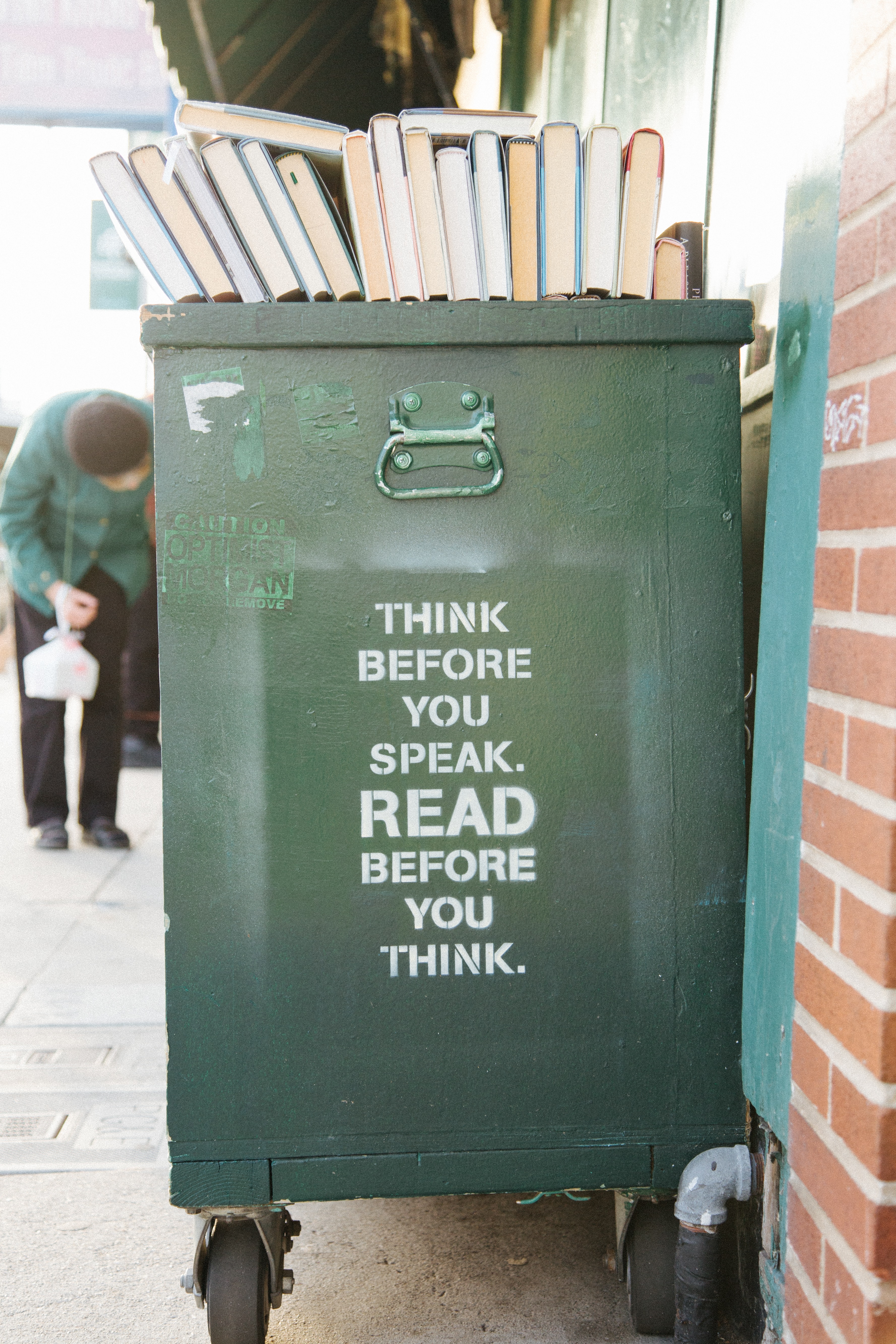
Book bin with quote on the side: \' Think before you speak. Read before you think\'
Photo: Kyle Glenn/unsplash.com

Foundation Core Skills

What are three new things you have learned about yourself and your ego as a result of the core learning?

  • That once I fully grasp a concept, I tend to get a lot more confident and excited about tackling more difficult problems.
  • I've most definitely got the capacity to learn new concepts, but getting better at those things will take time and practice.
  • Speed kills, sometimes. I can get too eager to jump into doing an exercise and neglect reading the whole thing properly or coming up with a plan for success.

What are the role of values, empathy and self awareness in learning and programming?
Values will guide your decision making on what work to take on and how to deal with people that don't treat you in a manner that aligns with those values. Empathy will help you work with people from all walks of life, as well as facilitate the building of relationships. That, combined with self awareness will aid in preventing and/or resolving any conflicts you might encounter. A healthy self awareness will also help you overcome any learning obstacles, as you will be able to recognise when you are getting down on yourself and utilise other tools in you skillset to get you out of that funk.

What has surprised you the most about the core learning?
Listening and looping was amazing. It's such a good exercise, as it helps you develop your mindfullness, self awareness and your empathy skills.

An intentional conversation
Photo: Mimi Thian/unsplash.com

What were the most challenging aspects of the core learning?
The identity and values exploration was quite an intense exercise. Reflecting on who you really are can sometimes be uncomfortable and bring up things that you're not necessarily wanting to, but incredibly valuable when you take it seriously, as it can really help you evaluate what's important to you and your situation in life.

Why do you think we, a programming school, are spending so much time focusing on core learning in a web development bootcamp course?
The pandemic has brought working practices into stark perspective. Remote working is going to become a much more readily accepted option for businesses, and as I personally have experienced during the lockdown, online communication can be tricky at times. Therefore, have good HR skills is an absolute must in that situation, as is when working as part of a team, which is what a lot of programmers end up doing. The core components of the course just helps you become a more well-rounded and resilient person and programmer.

Does the time you spent studying core learning here feel like a waste of time? Should you have just used that time to practicing programming instead? Justify your answer.
In short, no. The core learning has really had a positive effect on how I learn as well as keeping up my determination to push through difficult situations (in a problem solving sense).

Preparing for Bootcamp

What is your long term goal and/or career pathway?
This still hasn’t changed from what I wrote in sprint 2. I want to be able to help make a positive impact, socially, economically and environmentally. I would ideally be able to work for an existing business with these goals so that I can get some good experience building my skills and experience, as well as build new relationships and make new friendships. From a technical point of view, I'd ideally like to be able to expand beyond just web development as well, so learning other languages in order to build standalone software would also be good.

A comical goal timeline graph
Photo: Isaac Smith/unsplash.com

What do you think your biggest strengths and limitations will be in Bootcamp?
Biggest limitation would probably be perfectionism. I will really need to avoid getting bogged down in the details, otherwise I will get behind.
Biggest strength will hopefully be my EQ/EI when we are pair programming, as that will be a very important thing to get right.

What do you think your biggest non-technical challenge at Bootcamp will be?
Time management. I have become better at managing my time during Foundations, but I will need to continue getting better at it during Bootcamp. Also, I've never been confident when speaking in front of a large group of people. It would be good to get better at that, as it will be important when I eventually move into leadership positions.

What non-technical skills - human skills - would you like to see developed in yourself while at EDA?
I'd like to improve my reflective skills as well as build up some leadership skills as well. In the past I've never really been big on self-reflaction, but Foundations has definitely improved that. Developing coaching skills would also be very beneficial, especially in a leadership position.

What are your expectations of yourself on Bootcamp?
I really want to focus on staying accountable for my learning with my accountability partner/s. As I learn new things, I will start to write a detailed plan of the learning path I'd like to embark on once we get to week 7. With the new knowledge, I'll have a better idea of what's possible with web technologies and what other technologies I want to get to grips with in order to achieve my long term goals. Keeping an eye on Seek for what employers are after will be one way of informing this, but shouldn't be the only driver. Consultation with course facilitators will be my primary way of determining what I want to explore. I'm really looking forward to Bootcamp. I just hope I'm properly prepared for it! Onwards and upwards!

SpaceX rocket lifting off
Photo: SpaceX/unsplash.com
Top of page ^

S4C3 :: 30.11.20
Brain 2.0

Top of the article ^

Time to get smarter

Neuroplasticity and ways to improve it

Sculpture with its brain exposed
Photo: David Matos/unsplash.com

By having the process of learning be the reward, rather than receiving a reward for being able to find the solution, you are more likely to make lasting learning connections in your brain. Practicing a newly learned piece of information and applying it to a project that is relevant to your own life experience will drastically increase the uptake and embedding of that information. Knowing that failing often at the start of learning a new concept is a great way to remove any preconceptions you might have about your own abilities in terms of learning.

Ways to improve neuroplasticity are: Learning new languages, Try new things, read as much as possible, stay curious, get enough sleep, exercise, meditate, stay hydrated, manage stress levels, maintain a social life.

Ways to improve memory: Avoiding distractions, learning in chunks, associative learning, memory games, minimise interruptions, take regular breaks, optimise background sounds, practice mindfulness.

The main takeaways for me are: in order to strengthen your learning, you need to practice the newly learned concepts; reviewing what you have learned and explaining it in a single sentence also helps strengthen the new neural pathways you have developed.

Developing a Growth Mindset

Seedlings illustrating growth
Photo: Markus Spiske/unsplash.com

Growth mindsets allow you to learn more effectively by avoiding preconceived (often negative) ideas you have about your own abilities. Fixed mindsets are the exact opposite to that and inhibit your learning ability.

In this mindset, the hand you’re dealt is just the starting point for development.

I have realised that for a lot of my professional life I’ve extended myself in some areas by utilising a growth mindset, but have hamstrung myself in others by adopting a fixed mindset.

Having a ‘not yet’ mindset can vastly improve your learning capabilities and resilience. Confidence can be a product of determination, will power and perseverance. Believing that your abilities can be developed can be a determining factor in your success. How do you eat an elephant? One mouthful at a time. Prove your ability to yourself in small ways enough times and you’ll become confident in them, creating a positive feedback loop.

Going into the bootcamp portion of the course, I will constantly remind myself that when I’m facing a problem, I will get it wrong sometimes, but in that process I will be learning. I will stop seeking approval from and comparing myself to others. Instead, I will celebrate my growth with others and also learn from others’ mistakes. I will also think realistically about time and effort. At times it takes me a bit longer to learn something properly than the suggested timebox. I’d be better off focussing on that until I’ve figured it out, rather than extending my knowledge to other areas, which I can do in my own time. Lastly, I will take ownership of my growth mindset attitude.

Top of page ^

S3C2 :: 23.11.20
Knowing thy self

Top of the article ^

EQ and IQ

One's Intelligence Quotient (IQ) is an indication of a person's cognitive abilities and intelligence. It can also be referred to general intelligence and is a variable that summarises positive correlations among different cognitive tasks. It's essentially a measure of a person's ability to solve problems to various degrees in different contexts.

Emotional Intelligence (or Emotional Quotient) can be described as a set of abilities that can be gained and/or improved with time and training. These abilities relate to one's interactions with others and how you let your emotions affect these interactions.

There are a few different models of EI/EQ: Goleman’s EI performance model; Bar-On’s EI competencies model; Mayer, Salovey, and Caruso’s EI ability model. I will be focussing on Goleman’s model.

"Although there are many models of emotional intelligence, they are often lumped together as “EQ” in the popular vernacular. An alternative term is “EI,” which comprises four domains: self-awareness, self-management, social awareness, and relationship management. Within those domains are twelve EI competencies, starting with emotional self-awareness in the self-awareness domain. Emotional self-control, adaptability, achievement orientation, and a positive outlook fall under self-management. Empathy and organizational awareness make up social awareness. Relationship management includes influence, coaching and mentoring, conflict management, teamwork, and inspirational leadership. Leaders need to develop a balance of strengths across these competencies. Assessment tools, like a 360-degree assessment that uses ratings from yourself and those who know you well, can help you determine where your EI needs improvement. To best improve your weak spots, find an expert to coach you." - Harvard Business Review


Table describing EI Domains and Competencies
Source: MORE THAN SOUND, LLC, 2017; HBR.ORG

What it essentially boils down to is that if you have a good balance of each of these EI competencies, the more employable you'll be and the higher likelihood of good business results occurring because of it.

The flip-side of having high EQ/EI

There always seems to be two sides to each coin. Whilst having high EQ/EI is an undeniably good thing, there are potential drawbacks as well. Feel free to read further about it in this Harvard Business Review article.

Further reading

The Theories of Emotional Intelligence Explained

Top of page ^

S2C1 :: 22.11.20
Setting the stage

Top of the article ^

My learning plan

Long term life and career goals

In the short term, I’d like to find a job where I can hone the skills and expand on the knowledge I’ve gained during my time at EDA. Long term, I would like to help shift our society towards one that is more sustainable: socially, economically and environmentally. What does this look like?

Companies and organisations that have B Corp status would be an example of someone I’d either like to work for or with. I would need to be able to build web-based and standalone tools to help achieve their aspirational goals. This means I’d need to be able to extend my language set and technology base beyond what I learn on this course, so I’d need to learn enough to be able to do that.

Human skills development

In order to be as effective as possible in reaching my goals, I will need to be able to lead a team effectively. This will require learning how to inspire people, how to coach and develop them, and to manage my time more efficiently.

Strengths and limitations

Strengths

Empathy, Curiosity, Objectivity & analysis, Building and maintaining relationships, self-starter.

Limitations

Following through on things; procrastinate when facing a problem where I don’t know how to start it; perfectionism.

Managing my bootcamp workload

Be intentional about my goals and challenges for the day and share them with an accountability partner. Ideally, I would write them down the night before and reassess before my day starts officially. At the moment, our schedule during parts of bootcamp hasn’t been confirmed yet, but as soon as I know what it will look like, I will discuss any potential issues with my facilitator and any affected peers. I have suspended all work arrangements during bootcamp and I will have organised any necessary childcare arrangements so that I can completely focus on my course. I will also set up an office away from home so that I won’t be disturbed at all. In order to avoid burnout, I will make sure to get exercise in and help with domestic chores during the 2 hour lunch break each day. I will also try to work in 9 holes of golf on Saturday afternoons :D Also, I will do my utmost to not waist time on small things only designers would notice.

Seeking help

If I am struggling with something and one of my peers can’t help me and using the Rubber Ducky approach doesn’t work, I will post a query on the relevant slack channels after the second attempt. If I fail a third time to solve the problem, I will contact my facilitator directly to get coached in the right direction. Ideally, after having listened to my problem and looked at how I’ve tried to solve it, I wouldn’t want the facilitation team to give me the answer, but rather ask me questions so that I can unearth the solution for myself, which will help me to learn. I thrive on building relationships with people, so ideally I would be paired with facilitators who don’t mind sharing things they are passionate about.

Last but not least

My overriding goal will be to be successful in my learning during this course, but I do have a young family and once I have a clearer view of what our schedule will look like during bootcamp, I will negotiate with the facilitation team any in-course time blocks I would need to dedicate to my family. I will try to keep these to a minimum where possible. After all, I am really enjoying what I’ve been doing so far!

Top of page ^

S1C3 :: 18.11.20
What I'm about

Top of the article ^

Identity, Values and Strengths

A question of ethics and values

Values: Faith, trust, respect, authenticity, peace

Ethics: Justice, inclusivity, equality

Whilst at university, I studied to become a graphic designer, and soon after graduating, I landed my first design job with a newspaper. I managed to stay in news-media with Fairfax/Stuff for close to 10 years. The newspaper market has been declining in the internet age, so big corporations like Fairfax have continually made cuts to its workforce.

In 2015, Fairfax’s Australian Community Media division faced some difficult decisions in order to protect its future. Unless drastic changes were implemented to save costs, they would face having to close 150+ community newspapers, which would also be to the detriment of the communities they served. It was decided that future-proofing their production tools and automating some processes was the way to go.

I was asked to work on the project to build the new production tools, as I was the only person in the company with specific knowledge in the design software they wanted to leverage. Therefore I was faced with an ethical dilemma: do I work on a project that would result in a large number of job losses? Do I trust that those in authority were motivated by more than just financial reasons?

My sense of justice told me that it would be better for a relatively small number of people to lose their jobs (which was going to happen regardless) during a relatively stable economic climate at the time, rather than the shuttering of hundreds of newspapers along with the direct job losses and knock-on effects it would have. I decided to accept the secondment to the project and helped build a production platform that is going strong to this day.

Cultural influences

From a cultural standpoint, faith/religion is a central component of the Afrikaner culture in South Africa. My Christian faith has helped shape my values and ethics. Jesus’ life and actions are a perfect example of what every Christian should strive for in their lifetime, and I believe the values and ethics I have listed reflect that. Am I perfect? Most definitely not, but that’s not an excuse for not trying to be!

Strengths and limitations in learning and working

Strengths: Empathy, Curiosity, Objectivity & analysis, Building and maintaining relationships, self-starter.

Limitations: Following through on things; procrastinate when facing a problem where I don’t know how to start it; perfectionism.

One thing that creatives sometimes suffer from is Imposter Syndrome - the sense that your skills are somehow not up to the mark compared to your peers - which can lead to a loss of confidence and self-esteem. I believe this is a form of perfectionism and is a killer when it comes to tackling new problems. It can lead to you not starting something for fear of doing it wrong, or not finishing something you have started for the same reason. I have struggled with this over my lifetime, but with the help of my wife - who is a prolific self-starter - I’ve managed to work on curbing this mentality. Sometimes you just need to get a minimum viable product (MVP) out there and build on it from there.

My curiosity and analysis should help me in my learning journey and career as a web developer, as they will drive me in finding more of the right information that I need to reach my goals. Self-discipline and self-awareness will be key to keeping this information-gathering within reasonable time-frames though.

Sometimes curiosity and analysis just might not be enough to tackle certain problems, which is where my relational and empathetic strengths will serve me well: collaboration. I love working with other people to brainstorm and solve difficult problems. Getting pushed to solve seemingly impossible problems is a big driver for me, so having someone that can push me will be of great benefit to me. In turn, I love sharing knowledge in order to help others reach their goals or to solve their own problems.

Project management obstacles

During my time at Stuff/Fairfax, I was asked to manage part of a big company-wide project. I had 2 peers as part of my team to get through the work in a tight time-frame. One of the team members wasn’t as skilled in the work that we needed to do, which at times created a bit of tension because of a lack of knowledge and experience. When this person was having difficulties keeping up with the work schedule, I used coaching strategies, as well as straight-up training to help them overcome their challenges. In order to be an effective coach/trainer, you need to have empathy and self-awareness, as you need to tailor your approach to the needs of the person you are helping.

I believe that you can facilitate people’s learning more by using coaching methodologies than just supplying them with the knowledge you have, because coaching involves problem-solving, whereas training just involves the sharing of knowledge. Coaching does however rely on the learner having a base knowledge of the subject, so switching between being a coach and a trainer involves some self-awareness and empathy.

Further reflections

Before reading any further, there are a couple of definitions I want to make. A person’s personality are the behaviours you are born with. A person’s character are behaviours you personally choose apply to your life.

I have immense respect for the field of Psychology and how psychologists delve into the aspects of your personality. During this process, I have read over my documented strengths, having completed a CliftonStrengths survey a while back. Reading through the different aspects of the key themes of my character, I couldn’t help but compare what has been written to how I see myself personally. Whilst a lot of the things that have been mentioned are accurate, they aren’t necessarily consistently active in my character. It’s an argument of weighting I guess. Weighing up which things apply considerably to your character, and which things you can work on developing further.

I thrive on building and strengthening personal and professional relationships. Whilst I don’t always go out of my way to build new relationships, I thrive when I’m amongst close friends and family and get opportunities to deepen those relationships.

One thing that I have learned to be aware of though is being too inquisitive in new relationships. I am curious by nature, which in the context of relationships is driven by my desire to be of service to those whom I love.

This has been a fantastic exercise, which has been quite revealing at times. I hope that you have enjoyed reading about what makes me tick!

Top of page ^